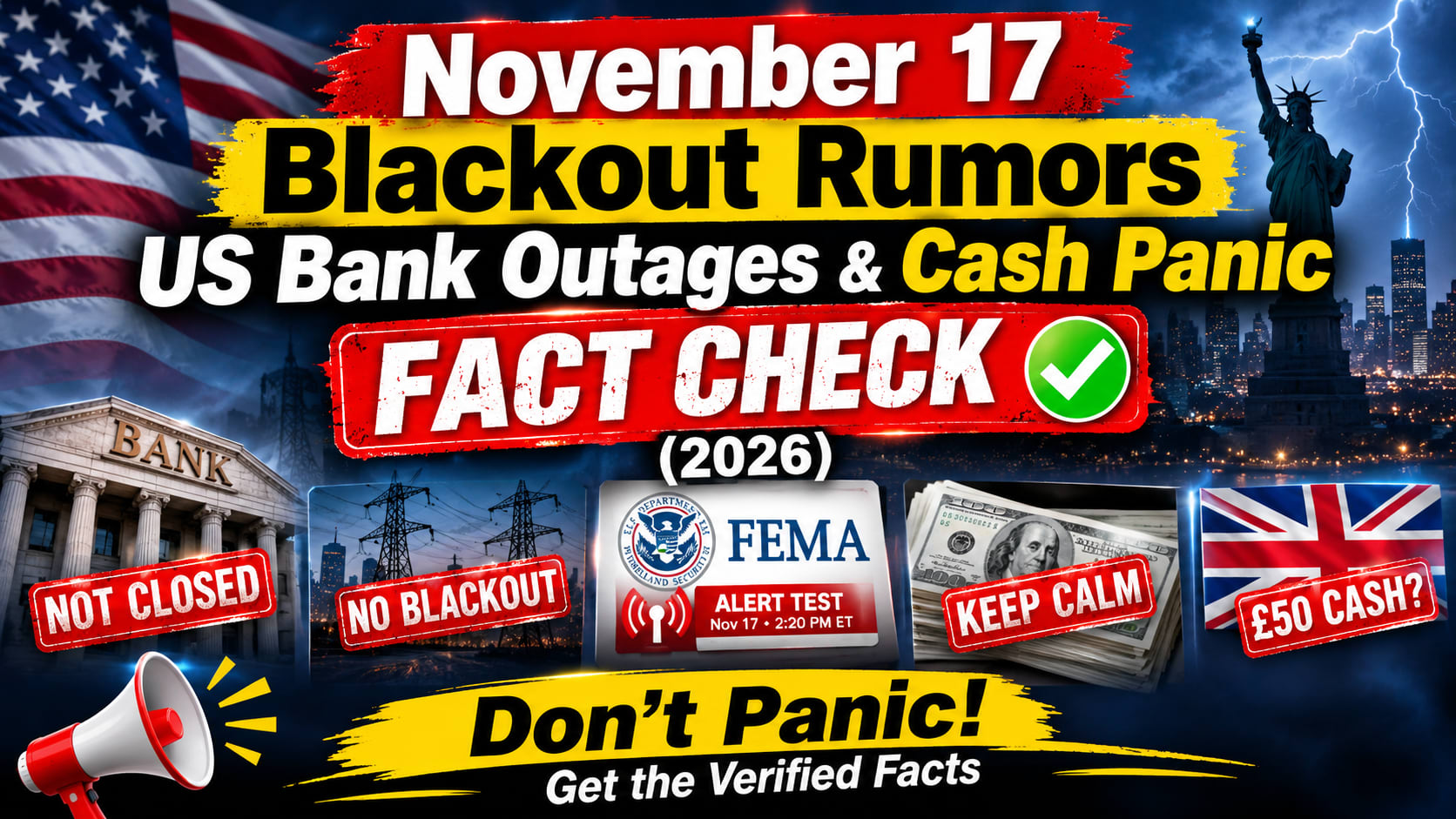
November 17 Blackout Rumors, US Bank Outages & Cash Panic: Fact Check (2026)
Are US banks closing or is a 90-day global blackout happening on November 17, 2026? Get the verified facts on Chase outages, FEMA's alert test, UK cash advice, and banking safety." date: "17 Nov 2026
November 17 Blackout Rumors, US Bank Outages, and Cash Panic: Fact Check (2026)
Over the past week, several separate real-world events unfolded in rapid succession: major aviation and cloud computing outages, a mobile banking glitch at America's largest bank, a tech-driven stock market pullback, a UK government winter preparedness campaign, and a scheduled US emergency alert test.
Online rumor mills merged these unrelated stories into a viral conspiracy narrative claiming a coordinated cyberattack, an imminent banking collapse, and a 90-day global blackout would begin on November 17, 2026.
If you are searching for whether banks are closing, if you should withdraw all your cash, or if the power grid is shutting down today, here is the verified, fact-checked breakdown of every major claim.
Quick Summary: November 17 Rumors vs. Verified Facts
-
Are US banks closed? False. JPMorgan Chase experienced an internal hardware software bug on November 16 that temporarily delayed mobile logins and transfers, but all funds remained safe and service was restored the same evening.
-
Is there a global 90-day blackout on November 17? False. No grid or internet shutdown is scheduled. FEMA and the FCC are simply conducting a routine, one-minute TV and radio Emergency Alert System test at 2:20 p.m. ET.
-
Will a cyberattack wipe out digital bank accounts? False. Banks rely on air-gapped backups, distributed ledgers, and legally binding paper records; a software glitch cannot erase account balances.
-
Were the FAA, Microsoft, and Chase outages a coordinated attack? Unproven. Official root-cause statements point to separate technical faults, and the Department of Homeland Security found zero evidence of a cyberattack.
-
Is the US banking system collapsing? Misleading. Six small regional banks failed in 2026, and all six were absorbed by acquiring banks with zero financial loss to FDIC-insured depositors.
-
Are governments telling citizens to hoard cash? Missing Context. The UK's routine "Be Ready" winter resilience campaign advises keeping around £50 in emergency cash in case storms or local glitches knock card readers offline.
-
Is the stock market crashing because of bank runs? False. Monday's tech dip was driven by Nvidia chip export restrictions and AI valuation concerns, while global banking indices remained strong.
1. Are Major US Banks Closed or Shutting Down?
Verdict: False.
On Monday, November 16, 2026, thousands of banking customers reported mobile app login errors, missing balance displays, and delayed Zelle or wire transfers. Outage tracker Downdetector recorded more than 4,600 problem reports for JPMorgan Chase by early afternoon, alongside secondary spikes for Bank of America, Wells Fargo, U.S. Bank, Truist, and Capital One.
However, no US banks were closed, frozen, or insolvent. JPMorgan Chase confirmed the disruption stemmed from an internal software bug in on-premise hardware systems—not a cyberattack or bank run. Because Chase processes massive volumes of interbank payments, its slowdown temporarily delayed transfers involving other banks whose own systems were operating normally. Chase resolved the glitch by Monday evening, restoring normal transaction processing.
2. Will a Global Blackout Shut Down Power and the Internet on November 17?
Verdict: False / Unfounded.
Viral posts across X, TikTok, and WhatsApp claimed the world would go dark for up to 90 days starting November 17, 2026, often citing edited clips or misattributed predictions from The Simpsons. Neither energy grid operators, telecommunications regulators, nor government agencies have reported or scheduled any power or internet shutdown.
What Is Actually Happening on November 17, 2026?
-
Routine FEMA and FCC Alert Test: At approximately 2:20 p.m. ET on November 17, 2026, the Federal Emergency Management Agency (FEMA) and the Federal Communications Commission (FCC) are conducting a scheduled, one-minute nationwide test of the Emergency Alert System (EAS), with a backup date of December 3 if severe weather or a real emergency intervenes.
-
TV and Radio Only: By federal law, FEMA must test public alert systems at least once every three years. Today's test broadcasts solely on television and radio; mobile phones (Wireless Emergency Alerts) will not sound an alarm during this test.
3. Can a Digital Apocalypse Wipe Out Bank Balances?
Verdict: False.
Chain messages circulating in multiple languages warned that an internet-wide hack on November 17 would permanently erase digital bank accounts and financial records.
Modern banking infrastructure does not rely on a single vulnerable database. Financial institutions maintain air-gapped backups, distributed transaction logs, clearinghouse records, and legally binding account documentation across geographically separated data centers. A temporary software glitch or network outage cannot permanently delete customer balances.
4. Were the FAA, Microsoft, and Bank Outages a Coordinated Cyberattack?
Verdict: Unproven (No Evidence of Cyberattack).
Within five days, the United States experienced three high-profile technical disruptions:
-
November 12: A global Microsoft outage disrupted Outlook, Teams, and Copilot across more than 70 countries.
-
November 13: The Federal Aviation Administration (FAA) issued a rare nationwide ground stop affecting roughly 10,000 flights.
-
November 16: JPMorgan Chase experienced its internal hardware software bug.
While social media influencers speculated about coordinated foreign hacking, official investigations point to separate infrastructure faults:
-
Microsoft attributed its outage to a months-old software bug triggered during a network capacity upgrade.
-
The FAA and Department of Transportation stated that a newly installed router malfunctioned during a contractor's transition from copper lines to fiber optics, overloading older air traffic control equipment.
-
Homeland Security leadership confirmed there is zero evidence of a cyberattack or foul play, describing the incidents as separate technical failures.
5. Is the US Banking System Collapsing in 2026?
Verdict: Misleading.
Social media posts cited 2026 bank closure statistics to suggest an imminent financial collapse. According to official Federal Deposit Insurance Corporation (FDIC) records, six small, FDIC-insured banks have failed in 2026—up from two in 2025, but far below historical crisis levels:
-
Metropolitan Capital Bank & Trust (Chicago, IL) – Closed January 30 ($261.1 million in assets)
-
Community Bank and Trust - West Georgia (LaGrange, GA) – Closed May 1 ($288.0 million in assets)
-
Kentland Federal Savings and Loan Association (Kentland, IN) – Closed July 10 ($3.7 million in assets)
-
Small Business Bank (Lenexa, KS) – Closed July 17 ($73.0 million in assets)
-
Tioga-Franklin Savings Bank (Philadelphia, PA) – Closed August 21 ($68.0 million in assets)
-
Nano Banc (Irvine, CA) – Closed September 25 ($736.0 million in assets)
In all six cases, acquiring banks assumed the deposits immediately, and insured depositors (covered up to $250,000 per depositor, per bank) experienced uninterrupted access to their money.
6. Are Governments Telling Citizens to Hoard Cash?
Verdict: Missing Context (Standard Emergency Advice, Not a Bank Run).
Rumors of mass cash hoarding stem from a misreading of the UK government's "Be Ready" campaign, alongside routine guidance from the UK ATM network LINK.
-
What the UK actually advised: As part of standard resilience planning for severe winter storms, power cuts, or local payment terminal outages, UK guidance recommends households keep a basic emergency kit—including bottled water, non-perishable food, a battery-powered torch, and a modest amount of physical cash.
-
Recommended cash amounts: LINK suggested keeping roughly £50 per adult and £25 per child in small notes and coins so households can buy essentials if card readers temporarily go offline. While UK cash withdrawals saw a modest seasonal uptick to roughly £1.46 billion in a week, LINK confirmed its ATM network remains well stocked and is operating normally.
-
What about the US? Neither the Federal Reserve nor the US Treasury has issued any warning to withdraw cash from banks.
7. Is the Stock Market Crashing Because People Are Pulling Out Money?
Verdict: False.
US equities experienced a tech-led pullback on Monday, November 16, with the Nasdaq dipping 2.49% and Nvidia shares dropping over 4%. Market analysts attributed the drop to tightened US export restrictions on advanced AI chips, analyst price-target cuts, and pre-earnings volatility ahead of Nvidia's quarterly report—not banking panic or power grid fears. Global banking indices remained resilient, with India's Nifty Bank hitting fresh highs on Tuesday morning.
How to Fact-Check Viral Blackout and Banking Rumors Yourself
When major technical glitches overlap with scheduled emergency drills, misinformation thrives on urgency and fear. Use these five steps before sharing breaking panic threads:
-
Check Official Status Pages First: Before believing a bank or telecom network is permanently offline, check official status dashboards, FDIC press releases, or FEMA's public alert schedule.
-
Separate Coincidence from Coordination: Large-scale cloud providers, airlines, and payment processors rely on complex hardware upgrades. Multiple outages in one week highlight infrastructure fragility, not automatically a coordinated cyberattack.
-
Look for Primary Numbers: Viral posts exaggerate small, routine figures (such as keeping £50 in emergency cash or six small regional bank resolutions over ten months) into systemic collapse narratives.
-
Verify Pop-Culture "Predictions": Claims that The Simpsons or old sci-fi media predicted a specific date are almost always fabricated edits created after a rumor starts trending.
-
Wait for Post-Incident Root Cause Reports: Engineering teams typically require several days to publish full post-mortem analyses. Early social media speculation is rarely accurate.
Practical, Low-Stress Emergency Preparedness Tips
You do not need to empty your bank account or stockpile months of supplies. Keeping a few sensible backups protects you against everyday disruptions like localized winter storms or temporary card-reader outages:
-
Keep a small cash buffer at home: Store enough small bills and coins for two to three days of groceries, fuel, or transit.
-
Maintain two ways to pay: Carry a backup debit or credit card on a different payment network (for example, both Visa and Mastercard) in case one processor experiences a temporary slowdown.
-
Save offline contact details: Write down key family phone numbers and your bank's customer support line on paper in case your phone battery dies or cellular data is congested.
-
Keep a charged power bank and flashlight: Basic power-outage gear handles 99% of real-world emergencies without stress or unnecessary expense.
Frequently Asked Questions (FAQ)
Is there a global blackout happening on November 17, 2026?
No. There is no scheduled or impending global power or internet blackout. The rumor stems from misinformation surrounding FEMA and the FCC's routine one-minute nationwide Emergency Alert System (EAS) test on TV and radio at 2:20 p.m. ET.
Why were Chase and other US banks down on November 16?
JPMorgan Chase experienced an internal software bug in its on-premise hardware on Monday, November 16, 2026, which temporarily affected mobile logins and delayed interbank transfers. Service was restored the same evening, and no customer funds were lost.
Should I withdraw all my cash from the bank right now?
No. Financial regulators and central banks have not advised withdrawing savings. While keeping a modest amount of physical cash at home (around $50–$100 or £50 per adult) is smart for temporary power or card-reader outages, your deposits remain protected by federal deposit insurance (up to $250,000 per depositor, per FDIC-insured bank).
Sources and References
-
JPMorgan Chase & Downdetector – Service restoration updates and outage reports (November 16, 2026).
-
FEMA & FCC – Nationwide Emergency Alert System (EAS) Test Schedule (November 17, 2026).
-
Federal Deposit Insurance Corporation (FDIC) – 2026 Failed Bank List.
-
UK Government ("Be Ready" Campaign) & LINK – Household Resilience and Emergency Cash Guidance (November 2026).
-
U.S. Department of Transportation & FAA – Preliminary Router Failure Statement (November 13–15, 2026).
-
Microsoft Service Health – November 12 Infrastructure Post-Incident Summary.
Disclaimer: This article is for informational purposes only and does not constitute financial or investment advice. Researched and written by Simarpreet Singh. Last updated: November 17, 2026.
Need help building something like this?
I help startups and businesses engineer high-performance web platforms (Next.js/Node.js) and cross-platform mobile apps (React Native/Flutter). Let's talk through your architecture and milestones.