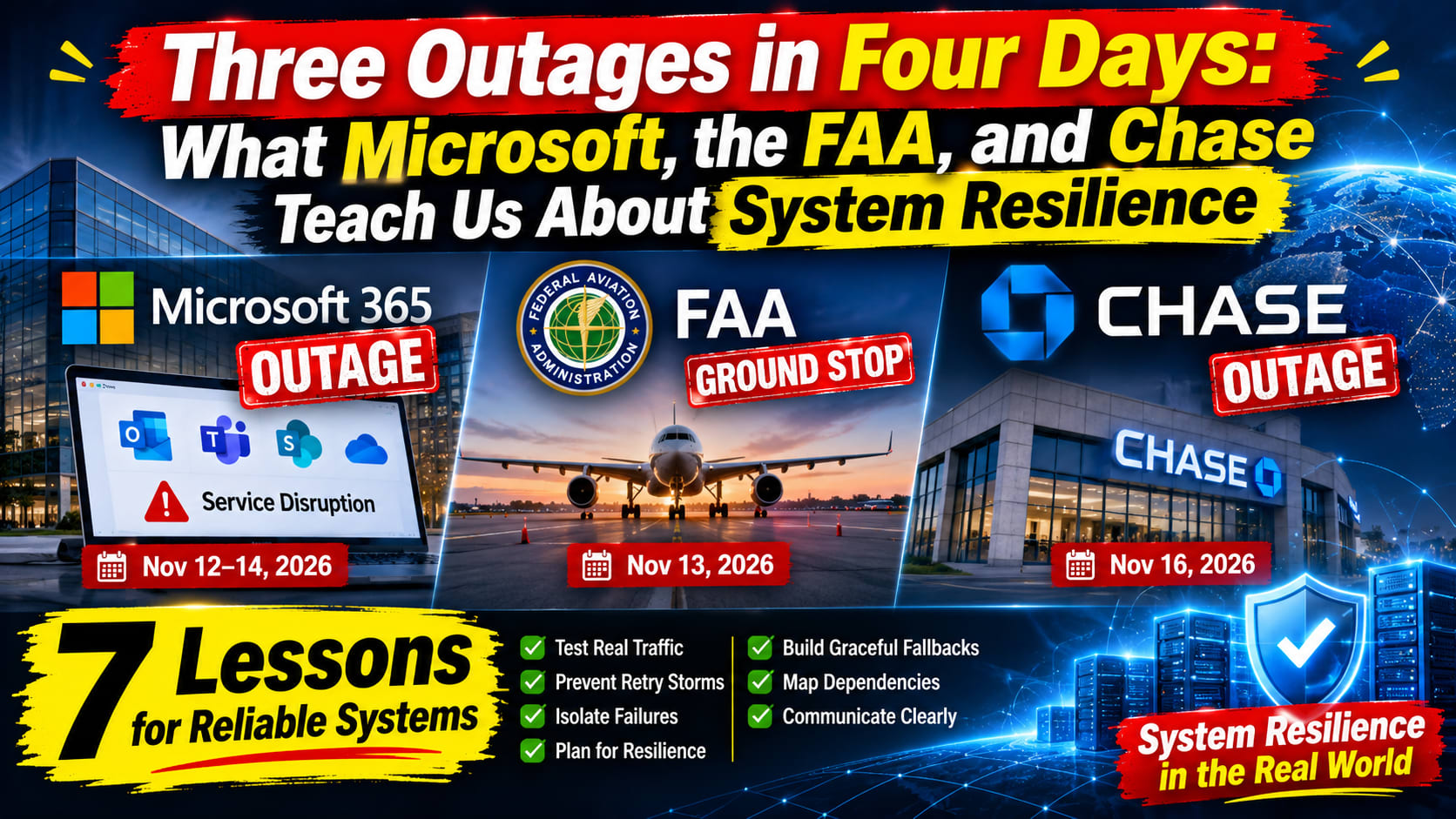
Three Outages in Four Days: What Microsoft, the FAA, and Chase Teach Us About System Resilience
Between November 12 and 16, 2026, Microsoft 365, the FAA air traffic network, and major US banks suffered massive outages. Here is what actually happened and 7 crucial engineering lessons for resilient systems.
Three Outages in Four Days: What Microsoft, the FAA, and Chase Teach Us About System Resilience
Between Thursday, November 12, and Monday, November 16, 2026, three critical, high-profile infrastructure systems failed in rapid succession across the United States and the globe: Microsoft 365, the FAA's national air traffic control network, and online banking services at major institutions like Chase. A separate United Airlines technology issue also grounded flights briefly on Monday.
Whenever multiple high-profile tech failures occur back-to-back, social media speculation immediately runs wild. Observers wonder whether it points to a coordinated cyberattack, a rogue AI agent, or hidden systemic fragility.
This post separates verified post-incident reports from online theories and focuses on the takeaway that matters most to software engineers, DevOps teams, and tech leaders: what these failures teach us about building robust, fault-tolerant distributed systems.
Status note: Written on November 17, 2026. Final post-incident reports from Microsoft and the FAA are still pending, and details may continue to evolve.
What Actually Happened? The Incident Breakdown
1. Microsoft 365 Global Outage (November 12–14, 2026)
-
The Impact: Outlook, Exchange Online, Teams, SharePoint, and Copilot went down for millions of users across more than 70 countries. Businesses, airlines, and government agencies experienced widespread disruption lasting over 24 hours.
-
The Root Cause: Microsoft's initial post-incident review revealed a compounding series of failures. A latent software defect—deployed via an update back in July 2026—had remained dormant for four months. On November 12, reduced server capacity combined with a spike in traffic overwhelmed the networking gateway, leaving over 80% of gateway servers unresponsive.
-
The Recovery Trap: When engineers attempted to recover nodes, automated failovers and heavy client retry traffic immediately flooded the recovering servers, creating a cascading failure loop that delayed restoration. Microsoft confirmed there was no cyberattack or AI-agent involvement.
2. The FAA Nationwide Ground Stop (November 13, 2026)
-
The Impact: At 3:54 p.m. ET on Friday, November 13, the Federal Aviation Administration (FAA) issued an emergency nationwide ground stop halting all flight departures across US airports for roughly four hours and twenty minutes—the longest such shutdown since 2001.
-
The Root Cause: Transportation Secretary Sean Duffy reported that a contractor, L3Harris, was replacing legacy copper wiring with fiber-optic cables at a remote FAA facility. During the transition, a misconfigured router began flooding the network with thousands of connection attempts every few seconds, overwhelming older legacy routing hardware and destabilizing air traffic data feeds.
-
What Officials Ruled Out: FAA leadership confirmed there was zero evidence of malicious activity or involvement from the FAA's new SMART AI traffic-planning tool, which is isolated from core flight-tracking networks.
3. Major US Banking Disruptions (November 16, 2026)
-
The Impact: On Monday morning and afternoon, customers attempting to log into Chase, Bank of America, Wells Fargo, and U.S. Bank faced login errors, missing account balances, and delayed transfers. Outage tracker Downdetector recorded over 20,000 problem reports for Chase at peak disruption.
-
The Root Cause: JPMorgan Chase confirmed the disruption was driven by an internal software bug within on-premise hardware systems rather than a cyberattack. Because Chase handles high volumes of interbank clearing, its processing slowdown temporarily created a ripple effect across connected financial platforms before normal operations resumed by Monday evening.
Why Outages Cluster: Separating Fact from Theory
When unrelated critical systems fail within 96 hours, conspiracy theories and "digital apocalypse" narratives inevitably flood social media. Cybersecurity analysts point out two competing realities during weeks like this:
-
The Coincidence of Complexity: Modern enterprise software stacks operate at massive scale with continuous deployment cycles. When thousands of complex distributed systems run simultaneously, statistical probability dictates that rare, dormant bugs will occasionally surface around the same time.
-
The Fragility of Shared Infrastructure: While official investigations into Microsoft, the FAA, and Chase confirmed completely separate root causes—ranging from latent July code defects to physical copper-to-fiber migration glitches—the clustering of failures exposes a broader truth: modern society runs on tightly coupled, highly optimized infrastructure with narrow safety margins.
7 Essential Engineering Lessons for Reliable Systems
These back-to-back incidents provide clear lessons for teams designing mission-critical architectures:
1. Test Against Production-Shaped Traffic
Microsoft's staging labs failed to catch the gateway bug because their test environments did not mirror the exact hardware profiles and traffic spikes of real-world production. If your staging environment is clean and predictable, it will never uncover the concurrency and load bugs your users encounter in the wild.
2. Guard Against Retry Storms
When a downstream dependency stumbles, naive clients configured to retry instantly will turn a minor blip into a total outage. Always protect your services by implementing randomized delays (jitter) between retries, circuit breakers to temporarily halt traffic to failing services, and strict retry limits.
3. Treat Infrastructure Migrations as High-Risk Incidents
The FAA ground stop originated during a routine physical upgrade from copper lines to fiber optics. Never underestimate physical or network-layer migrations. Always establish pre-planned rollback paths, incremental traffic shifting, and shadow-testing environments before cutting over core infrastructure.
4. Design for Failure Isolation (Bulkheading)
A single misbehaving router flooding a network brought national airspace departures to a halt because legacy equipment lacked proper traffic isolation. Use network bulkheads, strict rate limiting, and micro-segmentation so that one failing component cannot cascade into a total system blackout.
5. Build Robust Degraded Operating Modes
When your primary database, cache layer, or identity provider drops offline, what does your application display? Avoid raw error pages or blank screens. Design fallback mechanisms such as read-only cached states, local queueing for writes, and clear status banners to keep users informed.
6. Map Hidden Shared Dependencies
Many organizations assume their tech stack is independent, only to discover they rely on the exact same cloud providers, identity platforms, DNS hosts, or payment clearinghouses. Audit your dependency tree regularly to understand your true blast radius.
7. Prioritize Transparent, Real-Time Incident Communication
During high-stress outages, user trust is preserved through rapid transparency. Chase and Microsoft both published timely status updates while investigations were actively ongoing, reducing online rumors and helping downstream engineering teams manage their own incident response.
Frequently Asked Questions (FAQ)
Were the Microsoft, FAA, and Chase outages connected?
No. Official investigations by Microsoft, the FAA, and banking regulators confirmed that each incident stemmed from entirely separate technical root causes—ranging from latent gateway software bugs to physical router data floods—with zero evidence of a coordinated cyberattack.
Why did the Microsoft 365 outage take so long to resolve?
When Microsoft engineers attempted to deploy fixes and bring recovered servers back online, waiting client traffic immediately hammered the nodes, causing a retry storm that triggered repeat failures. Engineers had to carefully throttle traffic routing and stage server patches incrementally.
What can developers do to prevent cascading failures?
Engineering teams can prevent cascading failures by adopting circuit breakers, enforcing randomized delays on client retries, maintaining staging environments that mirror production load, and enforcing strict rate-limiting policies across microservice boundaries.
Sources and Further Reading
-
Microsoft Service Health – November 12 Infrastructure Post-Incident Summary and Root Cause Analysis.
-
NPR & U.S. Department of Transportation – FAA Copper-to-Fiber Contractor Upgrade and Router Flood Statement (November 15, 2026).
-
JPMorgan Chase & Downdetector – Service Restoration Updates and Outage Reports (November 16, 2026).
-
GeekWire & DHS – Official Statements Ruling Out Cyberattack and AI Involvement in the FAA Ground Stop.
-
Wikipedia – 2026 Microsoft Outage Timeline and Technical Overview.
Researched and written by Simarpreet Singh. Last updated: November 17, 2026.
Need help building something like this?
I help startups and businesses engineer high-performance web platforms (Next.js/Node.js) and cross-platform mobile apps (React Native/Flutter). Let's talk through your architecture and milestones.